Document Intelligence and Controlled Extraction
A pipeline that reads invoices, statements, forms, scans, and email attachments, converts them into structured data, validates the result, and routes uncertain cases to review.
- Documents in
- OCR + extraction
- Field extraction
- Validation rules
- Review queue
- Structured output
The operational problem
Financial documents arrive as PDFs, scans, and attachments, and their contents must become ledger entries, billing records, and filings. Retyping is slow; trusting extraction blindly is worse.
Why the existing process failed
Manual keying at volume produces transcription errors precisely where accuracy matters most, and pure-OCR approaches inherit every artifact of a bad scan without knowing they did.
What was built
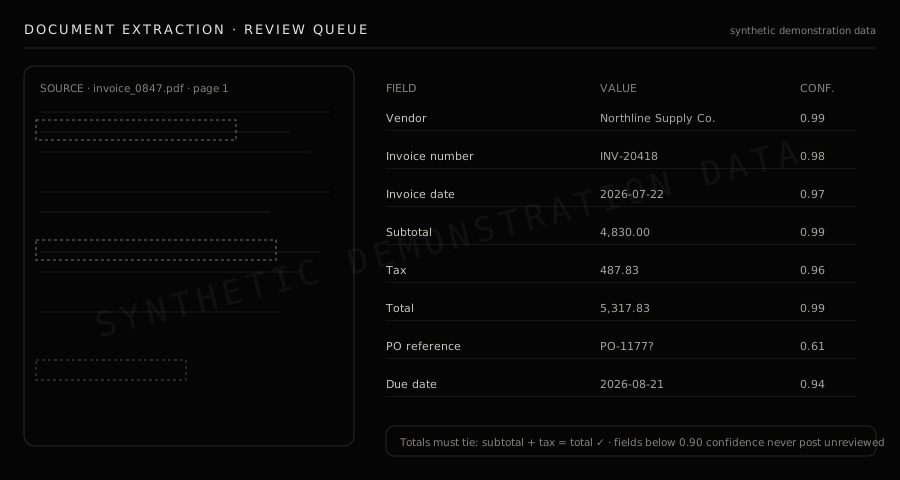
Document-processing pipelines combining OCR, structured extraction, and deterministic field validation (totals that must tie, dates that must parse, identifiers that must match patterns), attach confidence to every extracted field, and send anything uncertain to a human review queue with the source page beside it. Workflows in use include invoice, statement, and payroll-form processing, with structured export after validation and human review; implementation details vary by workflow.
What the system automates, calculates, and controls
Reading, field extraction, validation, cross-document tie-outs, and structured export. Nothing below the confidence threshold enters a system of record unreviewed.
Where human judgment remains
The review queue. The pipeline’s job is to shrink it honestly, not to empty it by pretending certainty.
How correctness was tested
Extraction output reconciled against control totals and, for financial documents, against the ledger entries they generate. Failure cases (skewed scans, unusual layouts) were collected into a regression set.
What changed
Document-driven work shifted from retyping to reviewing, with an evidence trail from every structured record back to its source page.
Disclosure
Operating in client and internal environments. Specific document volumes and sources are withheld where confidential.
Related service: Applied AI and document intelligence
Methods and research context
- Multimodal document intelligence Considered during system design